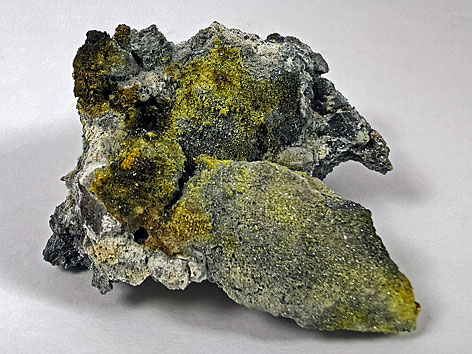
Challacolloit xx
La Fossa Krater, Insel Vulcano, Äolische Inseln, Sizilien, Italien
Stufe: 4,1 x 3,8 cm
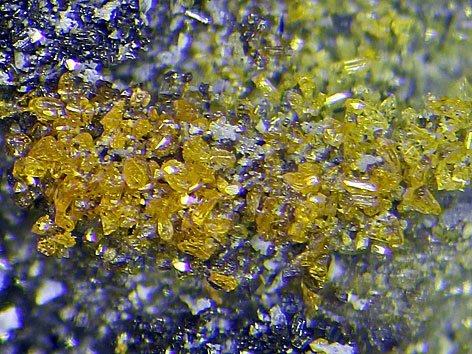
Challacolloit xx
Detail der links abgebildeten Stufe
Bildbreite: 2,5 mm
|
Challacolloit |
|
|
Formel: |
KPb2Cl5 (3.AA.55; Challacolloit-Gruppe). |
|
Ausbildung: |
monoklines Kristallsystem; farblos, weiß, gelb; prismatische Kristalle, dünne Krusten und botryoidale Aggregate. |
|
Entdeckung: |
2003 von Arturo Molina aus Iquique in Chile, auf den Halden der Challacollo Silbermine entdeckt. IMA 2004-028; 2005 - Schlüter & Pohl & Britvin. Das Mineral wurde benannt nach der Typlokalität Challacollo in Chile. |
|
Typlokalität: |
Chile, Region Tarapacá (I. Region), Provinz Iquique, Challacollo, Lolon Mine (Challacollo Mine). |
|
Seltenheit: |
höchst selten (mineralienatlas: 10 / mindat: 10 Lokalitäten; 2026). |
|
Challacolloit xx La Fossa Krater, Insel Vulcano, Äolische Inseln, Sizilien, Italien Stufe: 4,1 x 3,8 cm
|
Challacolloit xx Detail der links abgebildeten Stufe Bildbreite: 2,5 mm
|
Quellen: Sammlung und Fotos Matthias Kahl; allg. Mineralbeschreibung nach Mineralienatlas.de, Mindat.org, Handbook of Mineralogy, DeWikipedia und/oder Lapis-Mineralienmagazin
© copyright Matthias Kahl